
It is no surprise that coastal bears in Alaska benefit from salmon, who return from the Pacific ocean where they feed and grow to maturity, in order to spawn and die in the streams where they were born. Spawning salmon provide an incredible food source, which allows for the highest bear population densities and largest bears in the world. In the 1940s and 1950s fisheries managers knew this and concluded that if there were less bears, there would be more salmon. In an attempt to boost the fisheries economy, the State of Alaska considered heavy control of bears and other coastal predators. Today, our views of salmon feasting bears is quite different, and many studies have shown that the presence of bears is an integral part of the health of a salmon stream.
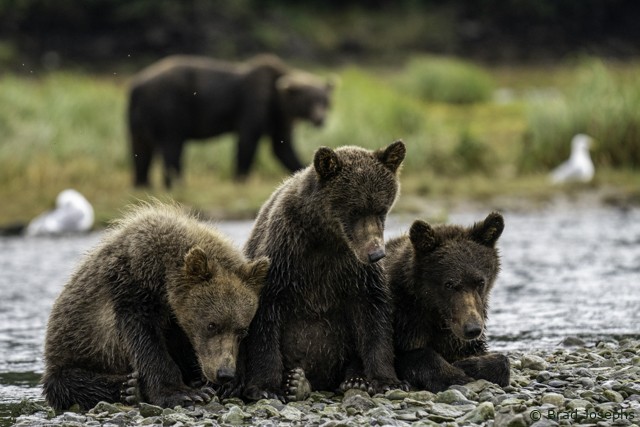
The salmon’s life is full of challenges, as they are the favorite food of dozens of species, including humans. As eggs, they are the favorite food for spiney fish called sculpins, and many species of birds. During maturity in the oceans they fall prey to commerical fishing boats, orca whales, salmon sharks, seals and sealions. When they return to the rivers of their origin, otters, foxes, wolves, wolverines and of course bears certainly take their share of salmon, although the majority of salmon in a bear’s diet have already spawned. When a bear catches a fish, they usually carry it into a secluded spot in the forest to eat away from other bears who may try to steal it. A bear normally eats about a quarter of the fish, concentrating on the fattiest portions, such as the brains, skin and eggs if there are any left. The rest of the salmon carcass, along with solid fecal waste from bears and other salmon eaters, are left to decompose into the soil, where it can be absorbed by trees and vegetation.

Numerous studies have utilized a technique to trace the orgin of nitrogen, a major building-block nutrient, that are found in the leaves of trees. The results have been astounding, and show that spruce trees on salmon rivers inhabited by feeding bears can be 3 times larger than similar salmon streams without bears and up to 70% of the nitrogen in the forest comes from salmon carcasses, most of which were brought ashore by bears! At the famous Brooks Falls in Katmai, the huge trees near the bear feeding areas are locally known as “salmon trees.”
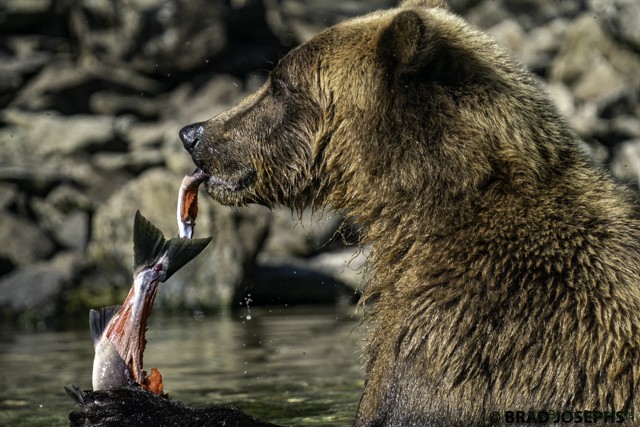
Many species enjoy the benefits of a healthier streamside forest, such as birds and insects, but it also greatly improves the ecology of the stream, and makes it a much more productive place for future salmon to spawn in. The larger trees eventually break off branches which fall into the water and create deep pools and hiding spots for the juvenile salmon to live during the first stage of their lives. The foliage adds cover and shade to the stream which reduces water temperature, and the enhanced root systems of the trees and plants reduce erosion, which improves water quality. In addition, if there were no scavengers, like bears, to clean up the stream of dead salmon carcasses, the river can suffer fungal outbreaks which can destroy the healthy salmon eggs which are buried in the stream bottom.
In some rivers of Washington State’s North Cascades, numerous projects focus on the conservation and enhancement of remnant salmon runs. At the same time, controversies rage about the natural recolonization of grizzlies which were eradicated from the region many years ago. By understanding how important bears are to salmon stream ecology, residents, biologists and wildlife managers will hopefully make good decisions and allow Canadian grizzlies from British Columbia to cross the border and reestablish their status at the top of the food chain, and as caretakers of the salmon streams. Check out the Grizzly Bear Outreach Program to learn more.
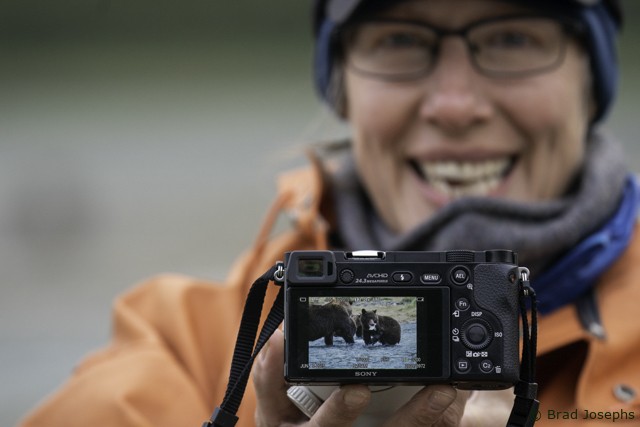
If you ever have, or are planning to travel to Alaska or British Columbia to view bears feeding on salmon, you may feel a little sorry for the salmon, who have traveled so far, and overcome so many odds, only to be caught and eaten by a bear in the final stretch of their journey. Hopefully now you can rest assured that in the bigger picture, those bears are invaluable stewards of their own ecosystems.


No Comments