

Borneo has always been a mythical destination in my mind since I was around ten years old. It is as wild and full of incredible creatures and indigenous cultures as any place on earth. I first came here in 2000 and spent 2 months tracking wild orangutans in extremely remote wilderness regions of Kalimantan, assisting a primate researcher. This time, I will be here for 6 weeks guiding two Natural Habitat Expeditions, with the help of the best local guides around. I spent the last two days scouting around and refreshing myself on tropical ecology and wildlife before my first group arrives. It has been amazing so far and I haven’t even gotten into the really wild areas yet.

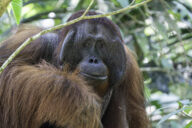
Huge male orangutan. The facial ridges, called “flanges” signify that he is a dominant male. This guy has a 7 foot long arm-span and legendary strength.
There are several places where orangutans that are rescued learn to live in the wild again, and receive supplemental feeding in addition to wild foods in the surrounding jungle. These are great places to get up close and personal to these amazing animals which are difficult to approach this close in the wild since they are normally high in the canopy. I was able to see a mother and a baby share a coconut after the mother removed the husk with her teeth, and then cracked the shell against a tree.

Mother drinking water from coconut before sharing the meat with her baby.

Mother and baby orangutans show so much affection.
According to the World Wildlife Fund, that has been working extensively to conserve Borneo since the 1970’s, there are only an estimated 50-80,000 orangutans in the wild in Borneo and Sumatra down from 230000 100 years ago. Habitat loss due to logging primary forest, and converting it to palm oil and rubber plantations is the chief cause of this decline. Not even an animal as charismatic as the orangutan can stop the demand for resources in these times of global growth.

Old female stares into the forest. Borneo has seen some of the most severe deforestation on earth since the 1950’s.
Borneo is incredibly rich in biodiversity. The forests, at 140 million years old, are among the oldest on earth and the island harbors 220 species of mammals, 440 species of birds and 15000 species of flowering plants! I spent a day exploring the mangrove and mixed diptocarp forests of Bako National Park and was stunned by what I found with the help of my guide local guide Paul Matthew. The highlight was finding two calugos, or flying lemurs! These are not true lemurs like in Madagascar, but in their own order Dermoptera. They are the best gliders of any mammal. Due to the unique uneven canopy-height of Borneon forests which make it difficult to travel between treetops, many species have evolved methods of gliding to cover ground. Calugos have huge flaps of skin which connect their limbs to glide, but this makes them quite awkward and easy prey for raptors, so they hide on the trunk of a tree during the day and search for food (insects) at night.

A calugo or flying lemur hiding on a tree trunk, Bake National Park, Sarawak.

Another calugo in Bako National Park, Borneo.

A mudskipper is really a fish, but it can survive outside of the water by storing air and water in its gills, Their pectoral fins act like flippers and allow them scoot in the mud to hunt fiddler crabs. These are likely the link between fish and amphibians.

A borneon bearded pig sniffs the air in its search for food.

A wagler’s pit viper rests on a branch in the strike-ready positon.

a skink clings to a sandstone cliff on the beach.

The beach cliffs are sandstone that have eroded into amazing shapes, and are filled with color from iron content. It was stunning and would have been worth the trip just to see this!

We did spot many incredible probocis monkeys, for which the park is most famous, as they leapt through the high canopy.

Another borneon bearded pig encounter added another highlight of the day.


3 Comments
Extraordinary photos, Brad. The orangutans are so beautiful…love the pig as well. All very interesting. I think I’ll start working on Michael for a trip to Borneo…be safe!
Brad Its 10 +
I’m impressed to see these wonderful pictures and lovely story. We’re glad we’ve met you (taxi Kuching airport to your hotel).